The Tracks Quest · Story
Alive & Kicking
Simple Minds
After their American breakthrough with the externally written Don’t You Forget About Me, Simple Minds needed to prove their own songs could compete. Alive & Kicking answered with arena-scale production from Jimmy Iovine and Bob Clearmountain, Robin Clark’s soaring backing vocals and a dramatic Catskills video.
- Year
- 1985
- Position
- #58
- Chart
- Trackslistan
The Scottish Arena Engine That Refused To Be A One Hit Wonder
In the autumn of 1985, Simple Minds found themselves trapped in a strange dilemma. They had conquered American radio with Don't You Forget About Me, a song written by someone else for a John Hughes film that they initially tried their best to avoid recording. Millions of record buyers thought of them as brand new heroes of the MTV generation, while Jim Kerr and Charlie Burchill carried eight years of Glasgow post punk grit, krautrock rhythms, and European art rock in their luggage. They desperately needed to prove that their own songs could hit just as hard.
Their answer arrived with the opening piano chime and booming bass drum of Alive & Kicking. Produced by Jimmy Iovine and Bob Clearmountain, the track sounded massive enough to fill every football stadium from Glasgow to Stockholm. Iovine pushed Kerr hard during the vocal takes, demanding more grit and direct emotional release. Kerr later recalled walking through Manhattan alone at dawn, listening to the final mix on his Walkman, suddenly realizing that they had pulled it off. Backing vocalist Robin Clark, brought in after her work on Bowie's Young Americans, provided the soaring soul textures that gave the chorus its huge, gospel-tinged weight.
01A Cliff Edge In The Catskills
The visual identity of this new era had to match the sheer physical scale of the music. For the music video, Polish director Zbigniew Rybczyński took the band up into the scenic Catskill Mountains in upstate New York. Looking at the video on television back then, you immediately assumed those misty peaks were somewhere in the Scottish Highlands. Instead, it was North-South Lake. Bass player John Giblin spent the shoot balancing dangerously close to a sheer vertical drop, an authentic stunt in an era before digital trickery took over.
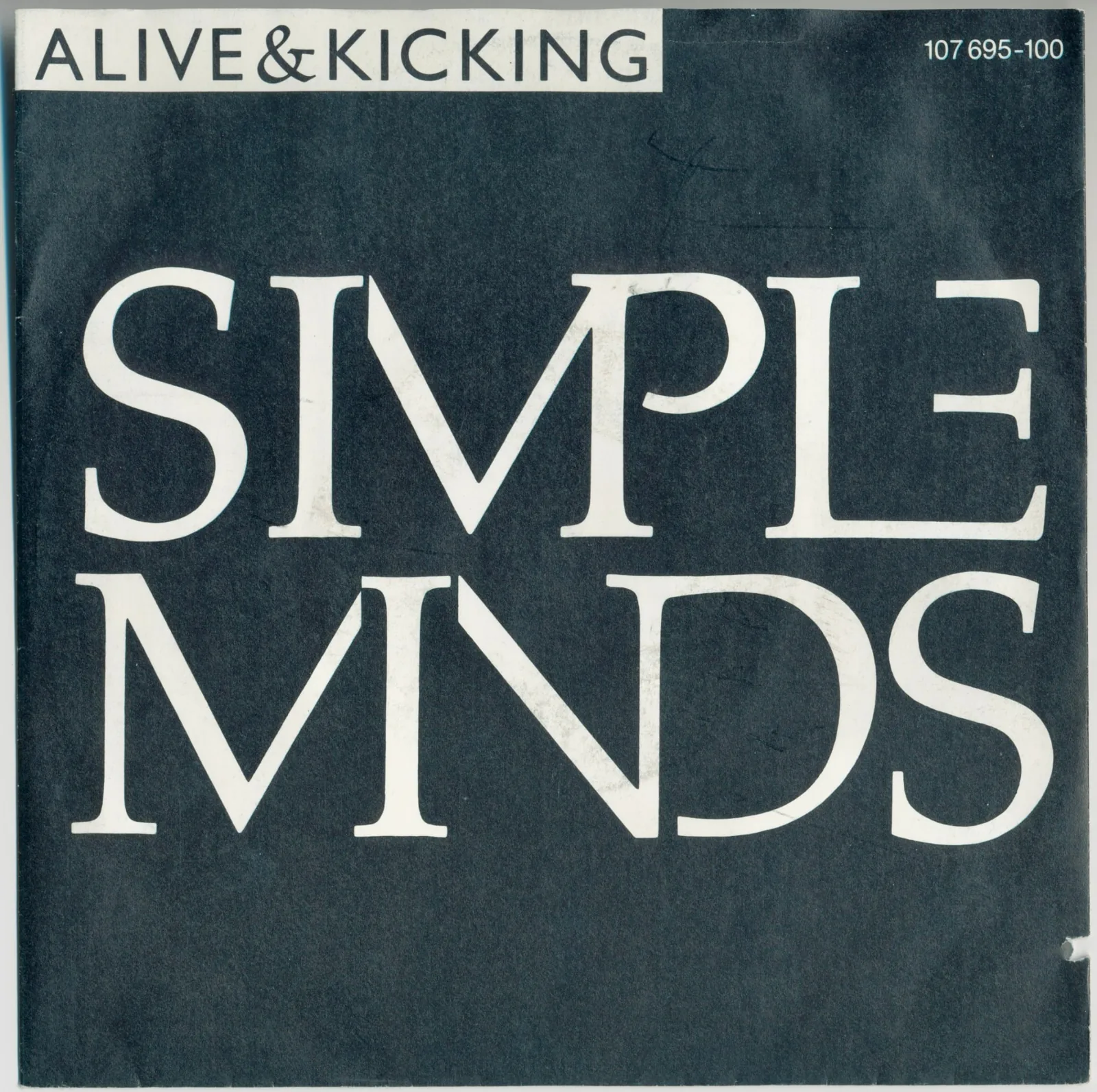
Meanwhile, graphic designer Mick Haggerty introduced the compact Simple Minds logo on the seven-inch sleeve. Anton Corbijn contributed photographs, including a shot of Kerr taken from behind on the Live Aid stage just a few months earlier, where Kerr famously doubted his own trousers. Everything about the package felt urgent, expensive, and determined.
“Everything about the package felt urgent, expensive, and determined.
What you gonna do when things go wrong? What you gonna do when it all cracks up? What you gonna do when the love burns down? What you gonna do when the flames go up?
02The Saturday Ritual On Trackslistan
For those of us sitting by the radio in Sweden on Saturday afternoons, Alive & Kicking was pure drama. On Trackslistan, the competition in late 1985 was fierce. Synth duos and glossy pop productions battled for the top ten every weekend, and hearing Kaj Kindvall spin this roaring, guitar-driven hymn felt like an electric jolt through the stereo. It sounded significantly tougher and more urgent than the smooth pop dominating the airwaves, yet the hook refused to leave your head. The seven-inch single quickly earned a permanent spot near the turntable, right where the records you actually play every week belong.
Filed under